If you’re planning for college or working your way through a degree, chances are you’ve worried about tuition, textbooks, and student loans. But a major shift in federal financial aid rules could change how colleges—and certain majors—get funded.

Under new federal accountability rules established in recent legislation (often referred to as the “One Big Beautiful Bill Act”), colleges are facing an earnings test. Starting in the 2028–29 school year, if graduates from a specific college major don’t earn at least as much as an average high school graduate who never went to college, that program could lose access to federal financial aid—including Pell Grants and federal student loans.
To see how students feel about this, ScholarshipOwl surveyed 9,531 Gen Z students across the country. The takeaway? Gen Z cares deeply about making smart financial decisions, but they also strongly believe that students pursuing essential, community-focused, and creative careers shouldn’t lose their financial safety net.
What Are the New College Rules (and Why Do They Matter)?

Federal policy jargon can feel confusing, but here is what the rule actually does in plain English:
-
The Test: The government looks at what graduates from a specific degree or certificate program earn a few years after finishing. If typical grads earn less than what a typical high school graduate makes in their area, the program fails the test.
-
The Penalty: If a program at a college fails consistently, students who enroll in that major won’t be able to use federal financial aid (Pell Grants or federal student loans) to pay for it, starting in 2028–29.
-
The Catch: While the goal was to stop predatory schools from charging high tuition for low-value degrees, real-world data shows that many vital programs are getting caught in the crosshairs. That includes majors in early education, healthcare support, social work, counseling, graphic design, and the arts—fields where starting salaries are often modest, even though society depends on them.
Who We Surveyed
We spoke with 9,531 high school and college students who use ScholarshipOwl to fund their education. Here’s a quick snapshot of who shared their thoughts:
Current Grade Level
-
High School Students: 67% (the vast majority being high school seniors)
-
College Undergraduates: 23% (about half in their first year of college)
-
Graduate Students: 6%
-
Adult & Returning Students: 4%
Gender Identity
-
Female: 62%
-
Male: 37%
-
Other / Preferred Not to State: 1%
Race & Ethnicity
-
White / Caucasian: 49%
-
Hispanic / Latino: 19%
-
Black / African American: 18%
-
Asian / Pacific Islander: 7%
-
Other: 5%
-
American Indian / Native American: 2%
The Survey Results: What Students Said
We asked four key questions to see whether students support the rule, how it might change their plans, and what concerns them most.
Do students think cutting off financial aid is a good idea?
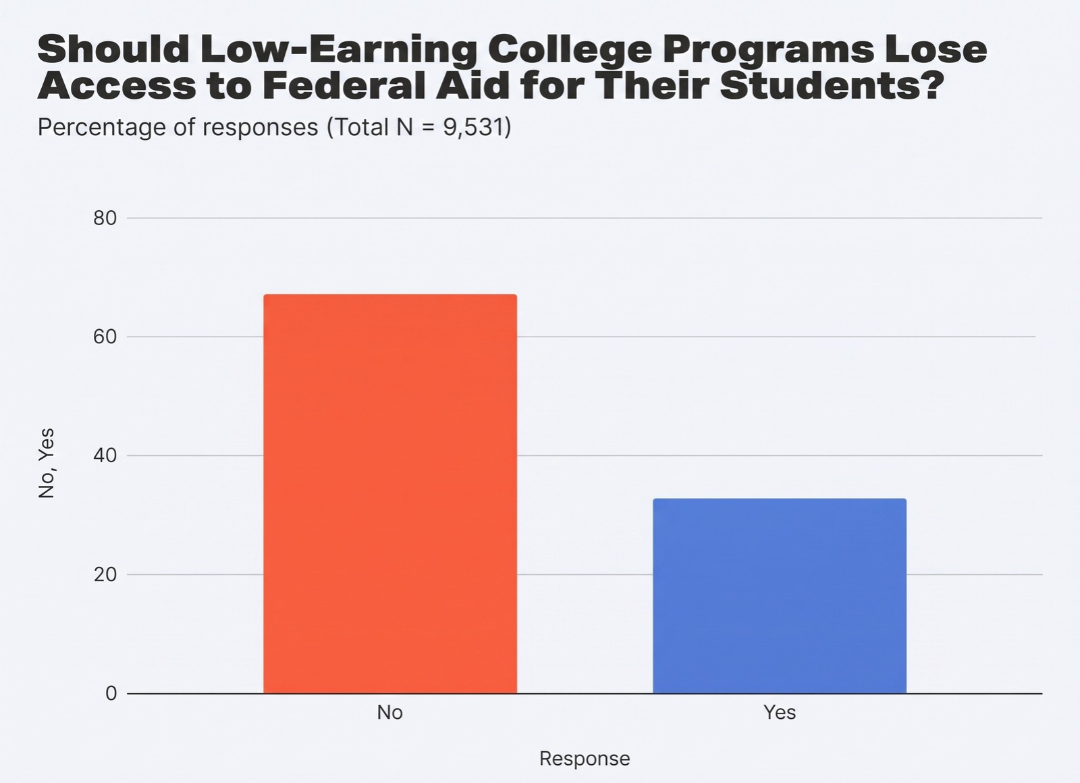
“New federal financial aid rules are focusing on college accountability data. Graduates of educational programs with average earnings that are lower than high school graduate earnings will no longer be eligible for Pell Grants or federal student loans beginning in 2028-29, compounding existing challenges with college affordability. In general, do you think this is a good idea?”
-
No: 66%
-
Yes: 34%
Two out of three students oppose this rule. While holding schools accountable sounds fair on paper, most students worry that blocking financial aid simply hurts people who want an education.
Would you switch your major if you knew it paid less than a high school diploma?
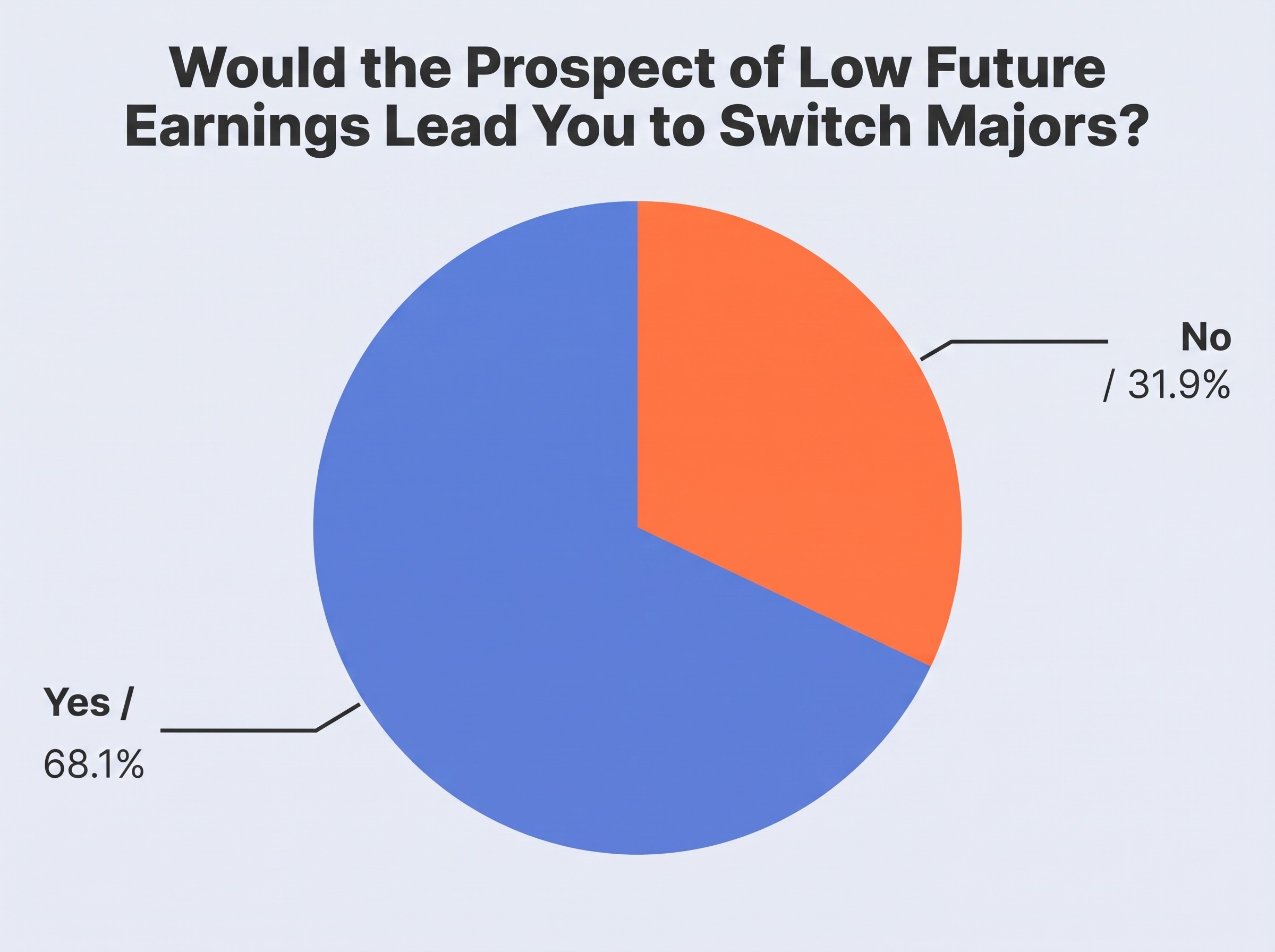
“If you learned that graduates with your intended college major typically earn less than someone with a high school diploma, would that information lead you to choosing a different major?”
Win more scholarships with less effort
Simplify and focus your application process with the one-stop platform for vetted scholarships.
Check for scholarships
-
Yes: 68%
-
No: 32%
Gen Z is practical about money. More than two-thirds said that finding out their future major pays less than a high school diploma would make them reconsider their path.
Would you pick a different college if their programs failed the test?
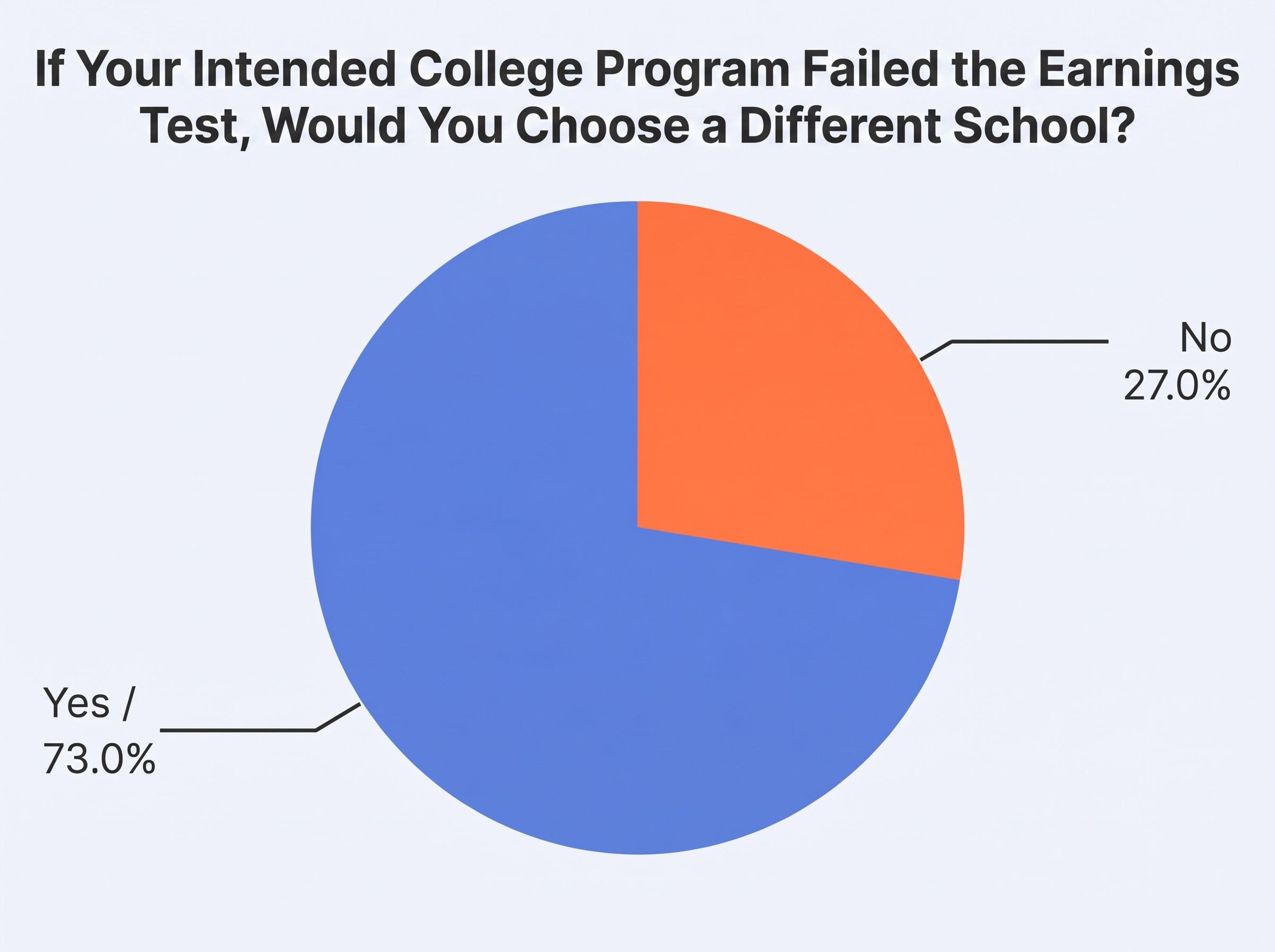
“If the college or trade school you are attending or plan to attend offers programs that failed the earnings test, would you choose a different school?”
-
Yes: 73%
-
No: 27%
Almost three out of four students said they would walk away from a school if its programs failed the earnings test. Students want confidence that the school they choose sets them up for financial stability.
How do you feel about so many different fields being affected?
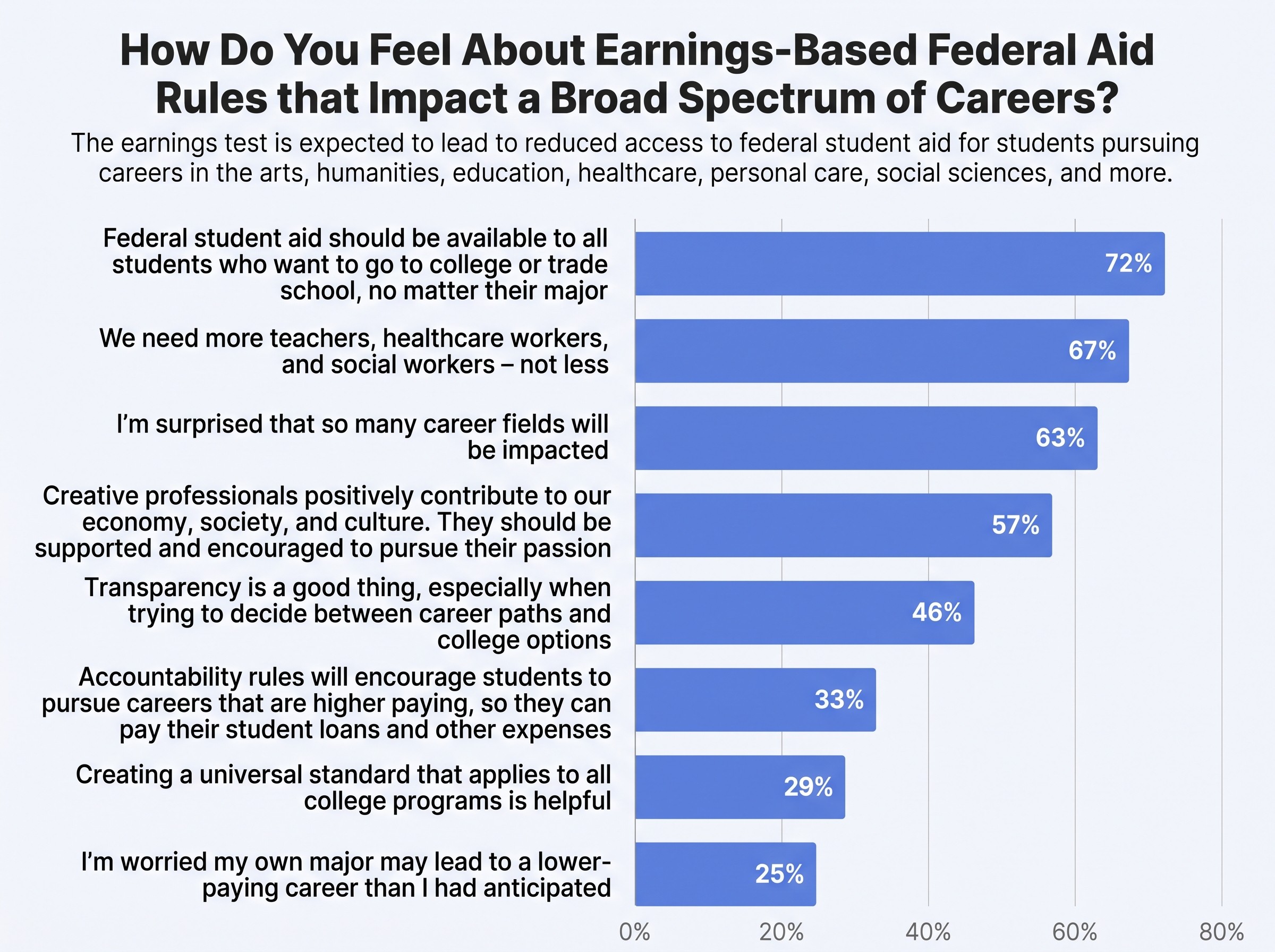
“Degree and/or certificate programs impacted by these new financial aid rules fall into multiple career areas including arts, education, healthcare, social sciences, business, and tech. How do you feel about this? (Select all that apply)”
-
72% — Federal student aid should be available to all students who want to go to college or trade school, no matter their major.
-
67% — We need more teachers, healthcare workers, and social workers—not less.
-
63% — I’m surprised that so many career fields will be impacted.
-
57% — Creative professionals positively contribute to our economy, society, and culture. They should be supported and encouraged to pursue their passion.
-
46% — Transparency is a good thing, especially when trying to decide between career paths and college options.
-
33% — Accountability rules will encourage students to pursue careers that are higher-paying, so they can pay their student loans and other expenses.
-
29% — Creating a universal standard that applies to all college programs is helpful.
-
25% — I’m worried my own major may lead to a lower-paying career than I had anticipated.
Key Takeaways

Students want data, not penalties.
Gen Z clearly values knowing how much graduates earn (46% love transparency, and 68% would change majors if the numbers were bad). But they believe data should be used to help students make informed choices—not as an excuse to yank away federal grants and loans.
Society needs fields that aren’t high-paying right out of the gate.
Over two-thirds of students pointed out that communities desperately need teachers, healthcare aids, and social workers. Taking away financial aid for these degrees could worsen shortages in critical jobs.
Colleges are on notice.
With 73% saying they would pick a different school if programs fail, colleges can’t ignore graduate outcomes. Students are paying attention to whether schools actually deliver on career prep.
For Parents and Counselors: Guiding Students Through the Data

Parents and high school or college counselors play an essential role in demystifying these federal benchmarks. Instead of viewing the earnings test as an obstacle or a reason to discourage a student’s dream, mentors can use this data as a constructive planning tool.
Reframe the earnings test as a quality and value filter
Help students understand that the rule doesn’t grade their ambition—it grades an institution’s ability to launch its graduates successfully. If a program fails, it often reflects high tuition paired with poor career placement, not a lack of worth in the field itself.
Use salary metrics to compare institutions, not just majors
Rather than telling a student to abandon creative arts, teaching, or human services, encourage them to look for colleges that deliver strong outcomes in those specific fields. A program with tight alumni networks, built-in internships, and reasonable tuition can pass with flying colors where an overpriced competitor might struggle.
Facilitate open, low-anxiety financial conversations
Walk students through realistic post-graduation budgets. Explore free tools like the U.S. Department of Education College Scorecard together to look at median borrowing alongside early-career earnings. Seeing the real numbers helps students make grounded choices without feeling blindsided later.
Emphasize stackable skills and proactive career prep
Counselors and parents can guide students to pair passion-driven majors with complementary minors, certifications, or technical electives (like project management, data analysis, or digital design) that lift starting salaries and enhance long-term career flexibility.
Champion debt-free funding strategies early
Encourage students to start applying for external scholarships well before senior year deadlines arrive. When a student builds an independent funding base, they protect their ability to attend the best-fit institution regardless of shifting federal aid rules.
What Should You Do If Your Major or School Is Affected?

If you hear that a program you’re interested in—or currently enrolled in—might fail the earnings test, take a deep breath. Here is how to navigate it step by step:
Don’t Panic
Failing this test does not mean your degree is useless, and it doesn’t mean you won’t find a great job. Many rewarding careers—like teaching, social services, and design—start at lower salaries early on, but pay increases with experience, certifications, and time. Also, the benchmark measures early salaries across large groups, not your individual potential.
Remember: The Rule Judges the School, Not the Major Everywhere
A psychology or visual arts degree might fail the test at one expensive private college, but easily pass at an affordable state university or community college. Look up colleges on the free U.S. Department of Education College Scorecard to see actual salary and debt figures for specific majors at specific schools.
If You Haven’t Enrolled Yet
-
-
-
Compare programs side by side: If you want to study music, education, or graphic design, check which colleges offer strong internships and high job placement rates without burying you in tuition debt.
-
Ask the college directly: Don’t be afraid to email the admissions office. Ask: “How are your graduates in this major doing in the job market, and will this program maintain federal aid eligibility?”
-
-
If You’re Already Enrolled
-
-
-
Check the timeline: The rule doesn’t cut aid until the 2028–29 academic year. If you are graduating before then, your current federal grants and loans won’t be suddenly cut off by this rule.
-
Add marketable skills: Talk to your academic advisor about adding a minor, certificate, or internship in business, digital tools, or communications to boost your starting pay after graduation.
-
Don’t rely exclusively on federal loans: Even without rule changes, avoiding heavy loan debt gives you freedom to take the jobs you truly care about.
-
-
Beat the Rules: How Scholarships Protect Your Future

Regardless of what federal policymakers decide, there is one rule that never changes: Scholarships are the safest way to pay for college because you never have to pay them back.
When you use scholarships instead of loans:
-
-
-
You don’t have to worry about federal aid rules cutting off your major.
-
You aren’t pressured to abandon your passion just to pay off a massive loan balance.
-
You graduate with financial freedom to start your career on your own terms.
-
-
Why ScholarshipOwl Makes Funding Simple
Hunting for scholarships can feel like a full-job search—scouring websites, writing repetitive essays, and filling out the same forms over and over. ScholarshipOwl was built to take that stress off your plate:
-
-
-
Instant, Tailored Matches: Fill out one profile, and our platform automatically matches you with verified, vetted scholarships suited to your grade level, interests, and major.
-
One-Click Applications: Apply to multiple scholarships without having to type your name, address, and GPA twenty times a day.
-
No Exclusions for Creative or Service Majors: Whether you’re studying nursing, early childhood education, fine arts, or engineering, our database has awards designed specifically for you.
-
-
Not yet a member of ScholarshipOwl? Get started today with a free 7-day trial!
Own Your Education

New college regulations can sound intimidating, but having the facts puts you in control. Keep researching, ask colleges tough questions about their outcomes, and never let a headline discourage you from pursuing a field you love.
By staying informed and actively applying for external scholarships, you can build a debt-free path to graduation—no matter what rules Washington writes next.
For Further Reading
- Is College Worth It? Survey Shows 97% of Gen Z Affirms the Value of College
- FAFSA 101: Everything You Need to Know to Navigate the Free Application for Federal Student Aid
- How Students Afford College in 2026: New Survey Reveals Gen Z’s Survival Strategies
- College Application Strategies: Get Accepted to Your Dream School
- OBBBA Student Loan Impacts: Everything You Need to Know
- Paying for College in 2026: Survey Reveals the Growing Funding Gap
- How to Find and Apply for Scholarships that Are Actually Worth Your Effort