


For Gen Z students, the decision to pursue higher education is more than a traditional rite of passage. It’s a calculated investment in their future. To uncover how today’s students perceive the value of a college degree, ScholarshipOwl conducted a national survey of 18,662 high school and college students.

Despite rising tuition costs and public debate surrounding the return on investment (ROI) of higher education, our findings reveal that Gen Z overwhelmingly still views a college degree as an indispensable foundation for career stability, personal development, and long-term financial security.
Who We Surveyed
Our survey represents a diverse cross-section of today’s student body:
Gender
- Female: 65%
- Male: 34%
- Other / Prefer not to state: 1%
Ethnicity
- Caucasian: 43%
- African American: 25%
- Hispanic/Latino: 19%
- Asian/Pacific Islander: 6%
- American Indian/Native American: 1%
- Other: 6%
School Level
- High School Students (mostly seniors): 46%
- College Undergraduates (mostly freshmen): 37%
- Graduate Students: 11%
- Adult / Non-Traditional Students: 7%
Survey Results
Question 1: Why is a college education important to you? (Select all that apply)
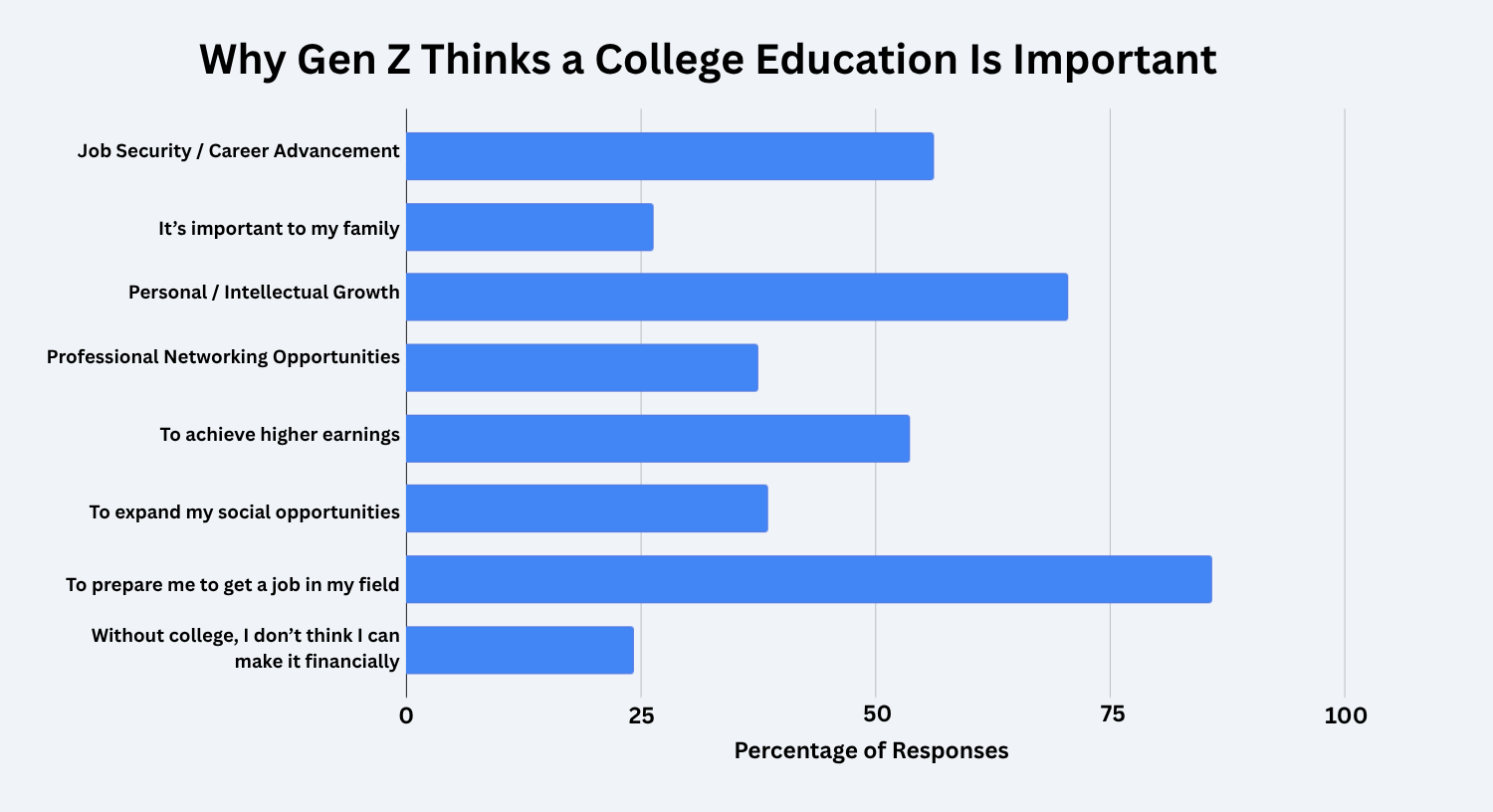
When asked about their motivations, students prioritized practical career outcomes while also placing value on personal growth.
-
To prepare me to get a job in my desired field: 86%
-
Personal and intellectual growth: 70%
-
Job security / career advancement: 56%
-
To achieve higher earnings: 54%
-
To expand my social opportunities: 38%
-
Professional networking opportunities: 37%
-
It’s important to my family: 26%
-
Without college, I don’t think I can make it financially: 24%
Question 2: In thinking about your own career goals, how important is it for you to have a college education?
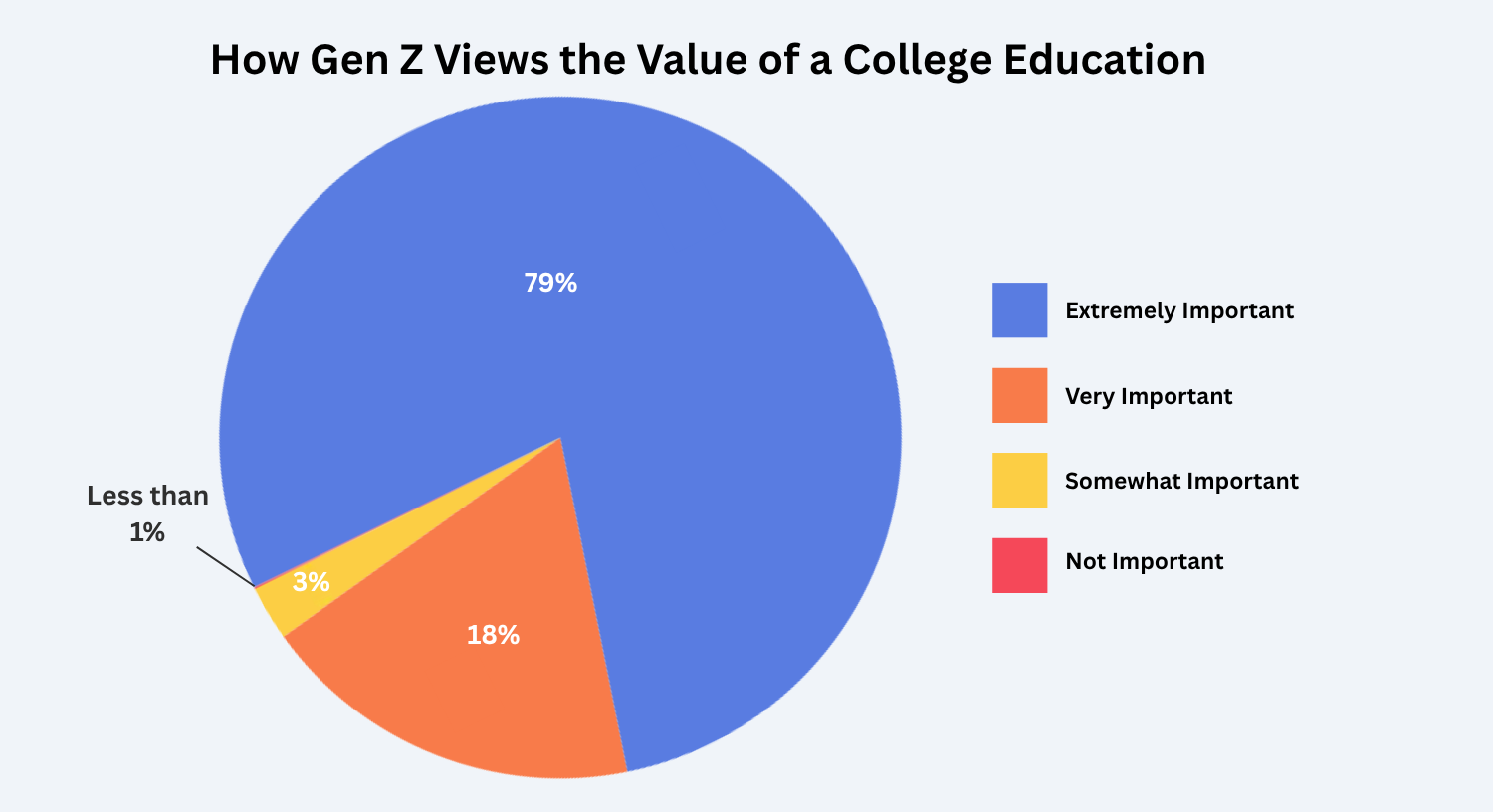
An overwhelming majority view higher education as a non-negotiable prerequisite to their professional goals.
-
Extremely important: 79%
-
Very important: 18%
-
Somewhat important: 3%
-
Not very important: 1%
Question 3: Would you take out student loans if you are unable to afford college without them?
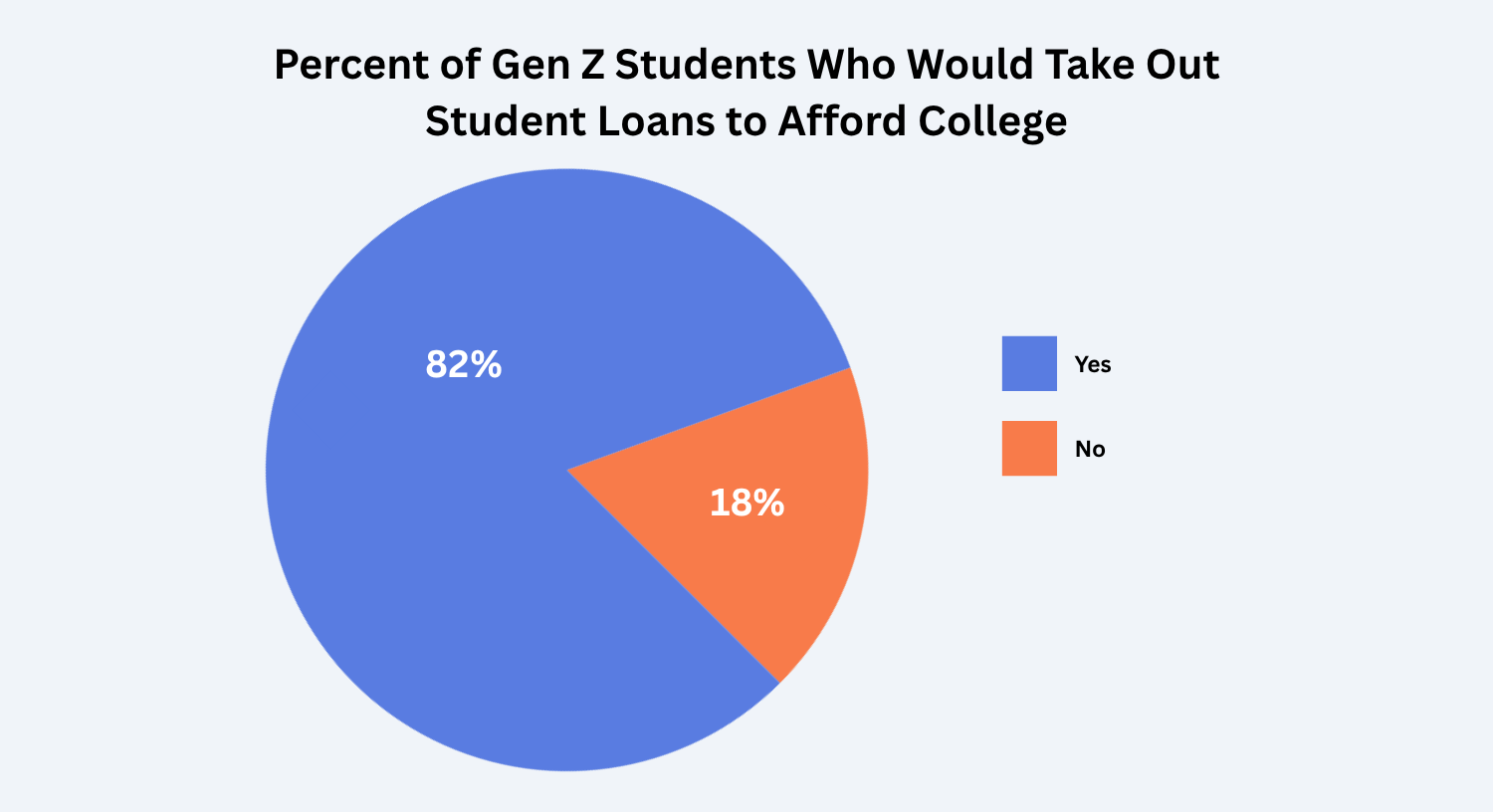
Faced with steep financial barriers, most students are willing to take on debt to ensure they do not miss out on a degree.
-
Yes: 82%
-
No: 18%
Key Takeaways
A College Degree Remains Highly Valued
A staggering 97% of surveyed students consider a degree either “extremely important” (79%) or “very important” (18%) to achieving their career goals.
Despite widespread media coverage, such as the Wall Street Journal highlighting Gen Z as the ‘Toolbelt Generation’ and National Student Clearinghouse data showing a 16% surge in vocational program enrollment, our data proves that traditional higher education remains the gold standard in the eyes of students. In fact, just 1% of our respondents said a degree was “not very important.”
Win more scholarships with less effort
Simplify and focus your application process with the one-stop platform for vetted scholarships.
Check for scholarships
For most Gen Z students, short-term certificates are not viewed as a sufficient replacement for a college degree.
Primary Motivation is Career Readiness

The primary motivation for attending college is career-driven, with 86% of survey respondents indicating they want a degree to prepare for a job in their desired field.
Sallie Mae’s How America Pays for College report underscores this financial weight, revealing that the average college family spent $34,019 on higher education in the 2025–2026 academic year, an increase of 10% compared to the previous year. With higher education continuing to climb, today’s students understand that preparation for employment and career advancement determines their financial future.
Intrinsic Value and Personal Growth Remain Vital
While job preparation is the primary reason that students feel that a college education is important, the desire for “personal and intellectual growth” was cited by 70% of respondents, outranking direct financial benefits like job security/career advancement (56%) and higher earnings (54%).
This mirrors sentiment found in Sallie Mae’s report, where 71% of college families view higher education as appropriately priced or even a bargain relative to its value. Students still find value in the holistic aspects of a traditional college experience.
The “Loan Willingness” Gap vs. Financial Reality
When asked if they would take out student loans if necessary, 82% of respondents answered “Yes.” This aligns with Sallie Mae’s findings that 75% of families state they would rather borrow than have their student miss out on college entirely. This willingness to borrow demonstrates that students are so determined to secure a degree that they may accept loans without fully exhausting debt-free funding avenues first.
Maximize Debt-Free Funding Before You Borrow

While 82% of students are prepared to take on student loans, borrowing shouldn’t be the default option. Before taking on debt, students should exhaust all sources of gift aid and earnings.
Federal and State Grants via the FAFSA
Completing the Free Application for Federal Student Aid (FAFSA) is the single most important step in securing debt-free funding. It unlocks a student’s ability to determine their eligibility for need-based federal and state grants that do not need to be repaid. By submitting the FAFSA, students may also be able to qualify for institutional need-based aid.
Despite this, Sallie Mae reports that 26% of college families skip the FAFSA entirely, often assuming their income is too high or that they won’t qualify.
Income from Student Work & Savings
Sallie Mae reports that student income and savings cover 10% of total college costs. Part-time work, federal work-study jobs, or campus employment enable students to cashflow a portion of their educational expenses, reducing their reliance on student loans. Employment also offers additional benefits, enabling students to develop skills and experience that build their resume and LinkedIn profile, and that can result in higher wages after they graduate.
Private and Institutional Scholarships
Scholarships are an often untapped source of funds for reducing out-of-pocket costs. Sallie Mae’s report reveals that 3 out of 4 students who didn’t receive a scholarship simply never applied for scholarships in the first place.
Fast-Track Your Debt-Free Journey with ScholarshipOwl

Googling for scholarships often leads to dead end results, outdated listings, and application fatigue. ScholarshipOwl transforms this experience by utilizing an AI-powered smart matching system that simplifies your path to debt-free college funding:
Personalized Smart Matching
Instead of digging through thousands of random listings, ScholarshipOwl matches your profile with vetted opportunities you’re eligible for, and that you have a higher likelihood of winning.
One Universal Application
Your ScholarshipOwl profile serves as a universal application, enabling you to save significant time. You literally won’t have to complete individual application forms, eliminating the hassle of re-entering basic details over and over again.
Built-in Essay & Application Tools
Access smart tools like AI essay support, deadline filters, and credibility scores to keep your application strategy focused on legitimate, high-value opportunities. You’ll be able to view the number of applicants for every single scholarship, enabling you to prioritize low-competition scholarships, boosting your chance of winning.
Automatic Re-Applications
For recurring draws and ongoing awards, ScholarshipOwl automatically re-applies you, keeping your application funnel full year-round with minimal effort.
The Lasting Power of a College Degree

Gen Z approaches higher education as a practical, necessary step for building skills and preparing for their career and future economic stability. They also feel that a college education provides intrinsic value, supporting their desire for personal and intellectual growth. Their instinct that higher education pays off is backed by hard economic data.
According to research from the Georgetown University Center on Education and the Workforce (The College Payoff), median lifetime earnings increase substantially with every step of educational attainment:
-
High School Diploma: $1.6 million
-
Some College (no degree): $1.9 million
-
Associate Degree: $2.0 million
-
Bachelor’s Degree: $2.8 million
Bachelor’s degree holders earn a median of $2.8 million over their careers, which is 75% more than those with only a high school diploma and $800,000 more than those with an associate degree. While alternative credentials and short-term certificate programs can offer quick entries into the workforce, a bachelor’s degree remains the most reliable pathway to compounding long-term wealth, career stability, and upward mobility.
Perhaps this is why 82% of students are prepared to take on student loan debt to reach their goals. But taking on debt should always be a last resort.
At ScholarshipOwl, we believe students shouldn’t have to compromise their financial futures to earn a degree. By dispelling scholarship myths, filing the FAFSA early, and applying for scholarships on the ScholarshipOwl platform, students can bridge their funding gaps and focus on what truly matters: reaching their full academic and professional potential. Not yet a member of ScholarshipOwl? Get started today with your free 7-day trial!
For Further Reading
- How Students Afford College in 2026: New Survey Reveals Gen Z’s Survival Strategies
- College Application Strategies: Get Accepted to Your Dream School
- OBBBA Student Loan Impacts: Everything You Need to Know
- Paying for College in 2026: Survey Reveals the Growing Funding Gap
- How to Find and Apply for Scholarships that Are Actually Worth Your Effort