


Congratulations, you did it! You walked across the stage, flipped your tassel, and officially secured that degree. It is a massive achievement, representing years of late-night study sessions, stressful exams, and personal growth. You should absolutely soak in every ounce of that well-deserved pride. But once the graduation cake is eaten, the caps are thrown, and the family goes home, a sudden wave of reality tends to hit. The highly structured world of syllabi, midterms, and designated semester breaks has vanished. In its place is a massive, wide-open future. If you are feeling a chaotic mix of wild excitement and low-key panic right now, don’t worry—that is the universal post-grad experience. At ScholarshipOwl, we can help you navigate the transition, unpack the emotional weight, and strategically map out your next steps after college.

The Beautiful, Messy Reality of Graduating
Graduating college is one of life’s greatest paradoxes. On one hand, it is incredibly liberating. For the first time in your life, you aren’t bound by an academic calendar. You get to decide what your daily routine looks like, where you want to build a life, and what kind of impact you want to make. The world is wide open, and that potential is deeply thrilling.

On the other hand, the sheer lack of structure can feel paralyzing.
The post-grad transition isn’t just a logistical hurdle; it is a fundamental shift in your identity. For most of your life, your primary identity has been “student.” Shifting to “working adult” requires a process of emotional and financial uncoupling from your family and your institution.
Taking on the full weight of your own livelihood is a heavy psychological shift. You’re transitioning from a world where your performance is graded by professors to a world where the rules are ambiguous and success is self-defined. This means taking responsibility for your own healthcare, groceries, taxes, and long-term security. It is completely normal to mourn the comfort and built-in community of college life while simultaneously being eager for the future. Give yourself permission to feel both emotions at once as you adjust to the weight of these new responsibilities.
The Post-Grad Checklist: Essential Tasks for Your New Reality
You don’t have to figure out the next forty years of your career this month, but you do need to tackle the immediate operational logistics of adulthood. Let’s break down your next steps after college – the essential pillars you need to focus on right now.

1. Solidify Your Housing Plan
Where you live impacts your finances, your mental health, and your job prospects. You need to approach this with both a short-term survival mindset and a long-term growth mindset.
The Short-Term Cushion
For many graduates, moving back into their childhood bedroom is the smartest tactical move available. It eliminates immediate rent pressure and gives you a safe harbor to launch your job search. If you do this, view it as a launching pad, not a permanent relapse into high school life. Use this time to hoard cash.

The Long-Term Launch
If you are planning to move out immediately or within the year, start researching the actual cost of living in your target city. Look beyond just the monthly rent price. You need to factor in security deposits (usually one to two months’ rent upfront), utility costs, internet, and commuting expenses.
The Roommate Factor
Unless you are graduating into a high-paying tech or finance role, living alone in a major city is usually a financial strain. Vet potential roommates carefully. Look for people with similar cleanliness standards, sleep schedules, and—most importantly—financial reliability.
2. Establish “Adult Rules” and Boundaries with Family

One of the most important next steps after college is to determine your living situation. If your immediate housing plan involves moving back through your parents’ front door, you need to have a proactive, potentially awkward conversation. You are no longer the teenager who left for college; you are an educated adult who has tasted independence. Simultaneously, your parents have adjusted to an empty nest. To avoid toxic friction, sit down within the first week and establish a formal “cohabitation agreement.”
Win more scholarships with less effort
Simplify and focus your application process with the one-stop platform for vetted scholarships.
Check for scholarshipsContribution
How will you contribute to the household? Even if they don’t charge you market-rate rent, offer to pay a nominal amount, or take full responsibility for specific bills (like the grocery bill or the streaming services).
Household Labor
Do not let your parents do your laundry or cook every meal. Step up. Take over specific chores, cook dinner a few nights a week, and maintain your own space.
Social Boundaries
Be transparent about your schedule. You don’t need to ask for permission to go out, but communicating your schedule out of respect prevents them from staying up until 2:00 AM worrying about you.
The Timeline
Have an honest conversation about expectations. Are you staying for three months? Six months? A year? Having an agreed-upon timeline keeps everyone accountable and reduces resentment.
3. Build a Realistic Budget

Do not wait until you land a corporate salary to learn how money works. Managing a small amount of money well is the only way to ensure you won’t blow a large amount of money later. One of the most crucial next steps after college is building a baseline budget based on your current reality.
Identify Fixed vs. Variable Costs
List out your non-negotiables—cell phone bill, car insurance, health insurance, minimum debt payments, and groceries. These are your fixed costs. Variable costs are your entertainment, dining out, and shopping.
If your family has been helping you with some of these essentials, such as your phone bill, insurance, food costs, etc., you’ll want to talk with them to arrive at a reasonable timeline that makes sense for when you’ll be taking on these expenses on your own. Be aware that the timeline that works best for you might not be the timeline that works best for them, so there may need to be some negotiation to arrive at a timeline that makes sense for everyone.
Calculate Your “Burn Rate”
If you are currently unemployed or working a part-time bridge job, you need to know your exact “burn rate”—the precise amount of money you need to survive each month. Subtract this from your current savings to see exactly how many months of runway you have before you hit a financial emergency.
The 50/30/20 Rule
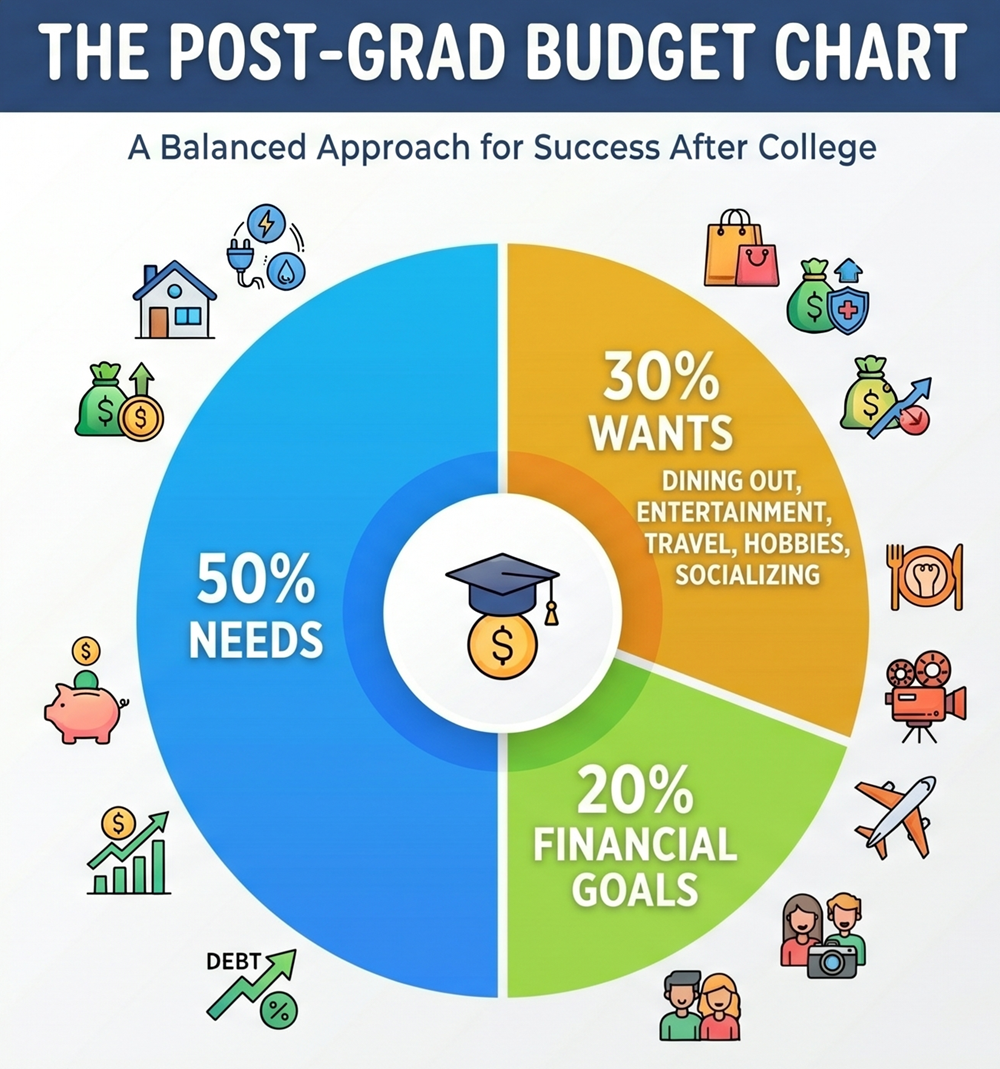
As soon as income starts rolling in, aim for a balanced framework. Allocate 50% to needs (rent, utilities, groceries, insurance, minimum payments for student loans, credit card bills, etc.), 30% to wants (socializing, dining out, hobbies, travel), and 20% towards your emergency fund, savings, larger payments to reduce your debt, and investments.
4. Upgrade Your Professional Profile
Before you start blasting out applications, you need to audit how you present yourself to the world when looking for a paid internship or employment in your field. It’s time to officially add that newly-minted degree to your resume and LinkedIn profile. However, far too many recent grads make the mistake of leaving their profiles looking barren because they think they lack “real-world” corporate experience.

Here is a major insider secret: recruiters do not just look at paid job history. When you lack twenty years of career history, your college ecosystem is your experience. Do not leave gold on the table. Make sure your resume and LinkedIn intentionally feature:
Academic Research & Special Projects
Did you write a senior thesis? Lead a semester-long marketing simulation? Build a functional app for a computer science capstone? Dedicate a section to “Key Projects” or “Research.” Break down your methodologies, the tools you used, and the outcomes.
Clubs, Organizations, & Affiliations
If you were the treasurer of your fraternity, a writer for the student paper, or an active member of the Society of Women Engineers, put it down. This demonstrates leadership, teamwork, and time management.
Volunteer Service
Community service highlights your character and initiative. If you organized a campus food drive or spent weekends tutoring, that is highly transferable project management experience.
Internships & Part-Time Jobs
Even if that summer job or campus gig felt minor, reframe it to highlight your soft skills—customer service, problem-solving, and reliability under pressure.
Curate Your Profile
Review your resume and LinkedIn profile for content that is no longer needed and/or is not relevant to where you are now in your professional career. For example, once you have a bachelor’s degree, there is no need to include your high school information. You can also omit mention of activities you were involved in prior to college if those activities are not relevant to your professional goals.
Sometimes, a hiring manager will skip past a generic internship description and stop at a unique research project or club leadership role you held. It shows personality, grit, and hands-on skill. So as one of your next steps after college, make sure to fill out those sections completely; they are often the exact catalyst that lands you the interview.
5. Attack Your Job Search Professionally

Once your professional profiles are optimized, you need a structured strategy to execute the actual job hunt.
Treat the Hunt Like a 9-to-5
Wake up early, sit at a desk, and dedicate specific hours every day to applications, networking, and skill-building.
Optimize for Applicant Tracking Systems (ATS)
Companies use AI software to screen resumes. If your resume doesn’t include specific keywords from the job description, a human will never see it. Tailor your resume for every single job you apply for. Given the challenging job market for new college grads, it’s imperative that you leverage AI yourself when looking for a job or internship.
The Power of the “Bridge Job”
Here is a hard truth: the professional corporate hiring loop can take months. In the meantime, your bills will not wait. It is incredibly easy to fall into the trap of using “I’m job-searching” as an excuse to sit on the couch and avoid taking an easier-to-obtain, short-term position. Do not let pride derail your financial health. Taking a temporary job—whether it’s bartending, retail, barista work, or data entry—is a badge of maturity. It ensures your critical baseline bills are paid, and it allows you to start building a savings cushion so you aren’t desperate.
Balancing Both Worlds
Working a short-term gig does not mean you have given up on your career. It simply funds your career hunt. Work your shifts, and use your off-hours to aggressively network and apply for jobs in your field. Employers actually respect candidates who show the work ethic to support themselves while pursuing their long-term goals.
Leverage Your Alumni Network
Cold-applying online has a low success rate. Instead, go to LinkedIn, filter for alumni from your university who work at your target companies, and reach out for brief informational interviews. An internal referral is worth a hundred blind applications.
6. Demystify and Face Your Student Loans

If you borrowed money to finance your education, the federal grace period (typically six months) will fly by faster than you think. Ignoring your student debt is the fastest way to ruin your credit score and limit your future options. Face the numbers head-on and plan for repayment now.
Audit Your Debt
Log into the Federal Student Aid website (or your private lender’s portal) and identify every single loan under your name. Note the interest rates, the total balances, and who your specific loan servicers are. This is one of the most important next steps after college. If you don’t know who your loan servicer is, go to StudentAid.gov to find out.
Understand Repayment Options
The standard 10-year repayment plan isn’t your only option. If your entry-level salary is modest, look into Income-Driven Repayment (IDR) plans. These calculate your monthly payment based on your discretionary income, sometimes bringing your monthly obligation down to $0 while keeping you in good standing.
Set Up Auto-Pay
Once repayment begins, set up automatic payments. Most servicers offer a 0.25% interest rate deduction just for enrolling in auto-pay, and it ensures you will never miss a due date.
One Step at a Time

The grand secret of adulthood is that absolutely nobody has it entirely figured out—everyone is learning as they go. Right now, your main objective isn’t to land a definitive dream job or perfectly curate the next decade of your life; it is simply to establish a firm, stable foundation. That’s why it’s so important that you tackle this list of next steps after college.
By upgrading your professional profiles, securing temporary income, setting your boundaries, and executing your job search one day at a time, that overwhelming mountain of “the future” becomes a series of completely manageable steps. Trust the skills you built over the last four years, celebrate the small victories, and welcome to the next chapter.
Looking ahead to grad school and wondering how you’ll afford it? Be sure to prioritize scholarships and income from a job rather than relying on student loans. Get started today with a ScholarshipOwl free 7-day trial.
Further Reading
- What I Did Last Summer: Level Up Your Life & Create the Most Meaningful Summer Ever!
- How to Use AI for Internships and Job Searching in 2026
- How to Find Paid Internships: Land Your Dream Role
- Managing Student Loan Debt: The Ultimate Guide for Graduating Students
- Scholarship Strategies that Put You on an Affordable Path to College
- From First Day to First Job: How to Build Your Network for Career Success
- Calling All Students: Summer Job Hunting Strategies that Earn Wages AND Education Benefits