
Confronting the reality of student loans can feel overwhelming, but if your career path leads you toward public service, a major federal safety net is available. The Public Service Loan Forgiveness (PSLF) Program is designed to wipe out your remaining federal student loan balance completely tax-free.

However, following the passage of the One Big Beautiful Bill Act and major federal rule updates, navigating student loan forgiveness requires knowing exactly which rules apply right now. This comprehensive guide breaks down how PSLF works today, highlights changes under the current administration, warns against common traps, and explains how you can completely bypass student debt using tools like ScholarshipOwl.
What is the Public Service Loan Forgiveness Program?
Established in 2007, the Public Service Loan Forgiveness (PSLF) Program is a federal initiative that forgives the remaining balance on your Direct Loans after you have made 120 qualifying monthly payments under an accepted repayment plan while working full-time for an eligible employer.

The PSLF Program was developed in response to critical labor shortages in public service professions:
- Public school teachers
- Nurses and healthcare workers
- First responders and law enforcement
- Legal aid and public defense lawyers
- Military service members
- Government agency personnel
Through the PSLF Program, the federal government helped to incentivize graduating students to pursue a public service career.
Who is Eligible for PSLF?
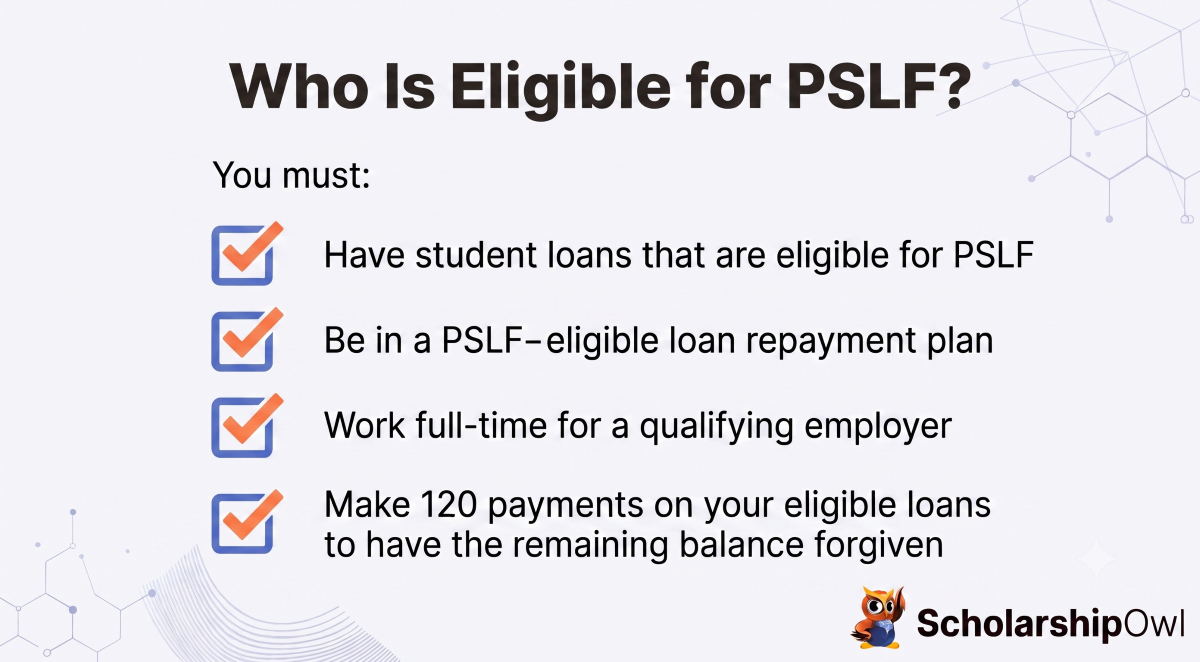
Borrowers must meet all of the following criteria are eligible for the PSLF Program. You must:
- Have student loans that are eligible for the program;
- Be in a loan repayment program that is designated as PSLF-eligible;
- Work full-time for a qualifying government agency or non-profit organization;
- Make 120 payments on your eligible loans to be able to access forgiveness on the remaining balance
Note that your job title and responsibilities don’t determine your eligibility. As long as your employer meets the federal definition for a qualifying employer, and if you meet all of the above criteria, you can apply for the program.
Fast Facts
PSLF can completely discharge your remaining loan balance.
Once you hit the 120-payment benchmark, 100% of your remaining federal Direct Loan balance is wiped clean.
Forgiveness is tax-free.
Unlike traditional Income-Driven Repayment (IDR) forgiveness, PSLF discharges are entirely exempt from federal income tax.
Even if you are eligible, you won’t be automatically enrolled in the program.
You must apply. Working for a non-profit or government agency won’t automatically result in forgiveness. You must actively submit documentation and align your loan types and payment plans perfectly.
Qualifying payments don’t need to be consecutive.
Your 120 payments (equivalent to 10 years) do not need to be consecutive. If you leave public service for a corporate job and return years later, your previous payment count pauses and resumes right where you left off.
Qualifying Employers
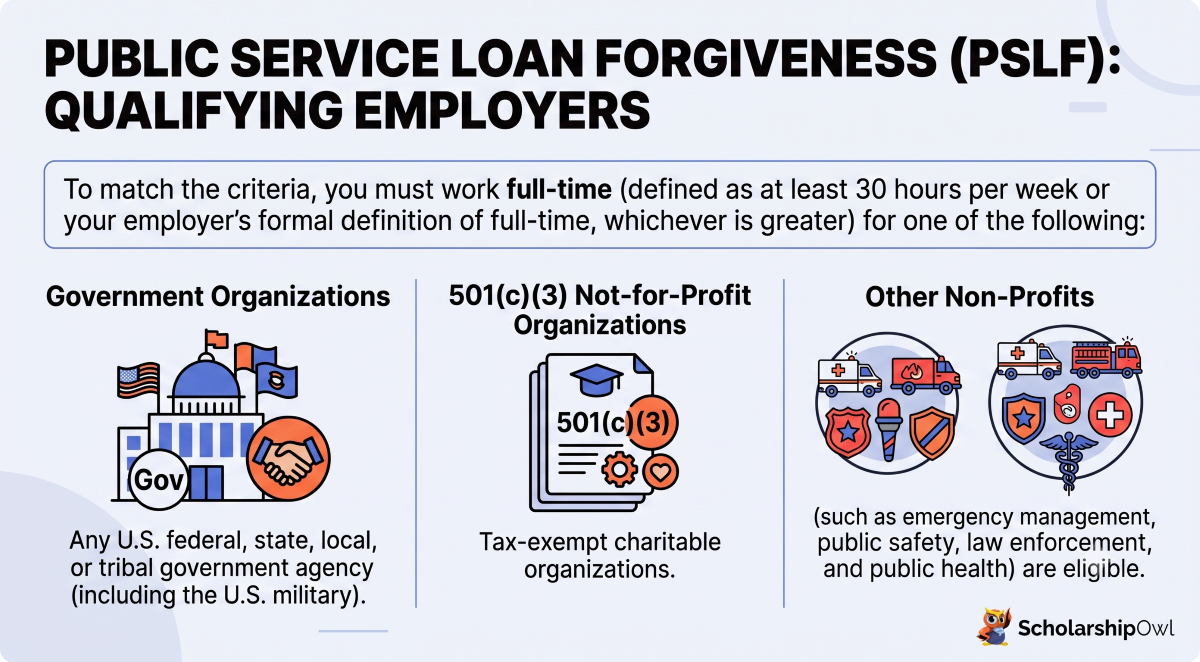
To match the criteria, you must work full-time (defined as at least 30 hours per week or your employer’s formal definition of full-time, whichever is greater) for one of the following:
Government Organizations
Any U.S. federal, state, local, or tribal government agency (including the U.S. military).
501(c)(3) Not-for-Profit Organizations
Tax-exempt charitable organizations.
Other Non-Profits
Private non-profit organizations that are not 501(c)(3) status but provide qualifying public services (such as emergency management, public safety, law enforcement, or public health) are also eligible.
Note: Labor unions, partisan political organizations, and for-profit government contractors never qualify for PSLF.
Eligible vs. Ineligible Loan Types & Repayment Plans
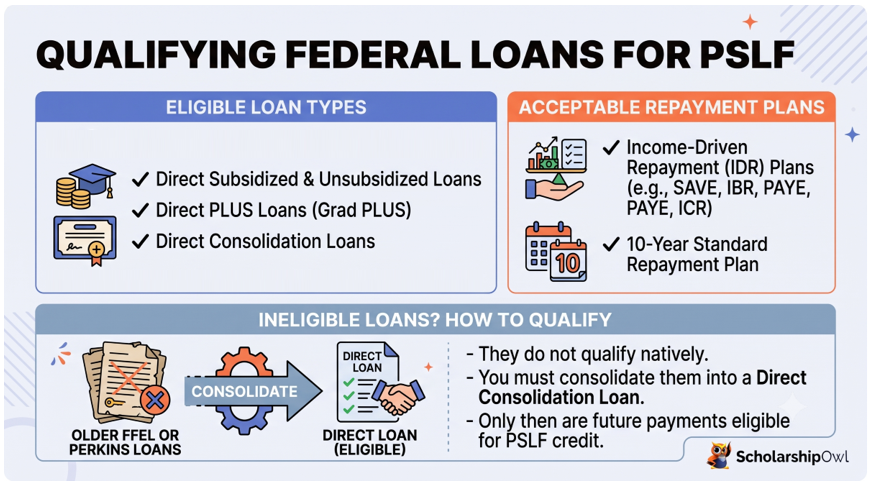
To earn credit toward forgiveness, you must match the right federal loan type with an accepted repayment plan.
Eligible Loan Types
Only loans from the William D. Ford Federal Direct Loan Program qualify. These include:
-
-
-
Direct Subsidized and Unsubsidized Loans
-
Direct PLUS Loans (Grad PLUS)
-
Direct Consolidation Loans
-
-
If you have older Federal Family Education Loans (FFEL) or Perkins Loans, they do not qualify natively. You must consolidate them into a Direct Consolidation Loan to make future payments eligible.
Eligible Repayment Plans
To build progress toward your 120 payments, you must be enrolled in an accepted repayment plan:
Win more scholarships with less effort
Simplify and focus your application process with the one-stop platform for vetted scholarships.
Check for scholarships
Repayment Assistance Plan (RAP)
The RAP Plan is a new repayment plan that launched on July 01, 2026. This is the only income driven repayment (IDR) plan available for loans taken out on or after July 01, 2026. It is also the only plan that is PSLF-eligible for new borrowers.
With the RAP Plan, payments are calculated as a graduated percentage of your adjusted gross income (AGI), starting at a minimum of $10/month and capping at 10% of AGI, minus a $50 monthly discount per dependent.
Borrowers with loans taken out prior to July 01, 2026 can either switch to RAP or they can remain in a legacy repayment plan (see below) that is PSLF-eligible, at least for now.
Legacy Plans for Loans Taken Out Prior to July 01, 2026
Income-Based Repayment (IBR) Plan
Fully available for loans disbursed prior to July 2026.
10-Year Standard Repayment Plan
Payments made under this specific plan count, though if you stay on it for the full 10 years, your loans will be paid off completely by the time you reach forgiveness. (Note: Standard Plans for consolidated loans that extend beyond 10 years do NOT qualify).
Pay As You Earn (PAYE) & Income-Contingent Repayment (ICR) Plans
Borrowers currently enrolled in Pay As You Earn (PAYE) or Income-Contingent Repayment (ICR) are grandfathered into eligibility, but must transition to RAP or IBR by July 1, 2028.
Ineligible Repayment Plans That Don’t Count Toward PSLF
Payments made under the following plans will not count toward your 120 required payments:
-
-
-
The Tiered Standard Plan
-
Graduated Repayment Plan
-
Extended Repayment Plan
-
Standard Repayment Plan for Direct Consolidation Loans (as these span 10 to 30 years)
-
-
If you are currently in a plan that is ineligible for PSLF, you may want to consider switching to a PSLF-eligible plan.
Common Mistakes to Avoid
Even with the best intentions, administrative missteps can derail your forgiveness timeline. Watch out for these common traps:
Failing to check for “Direct” status
Believing all federal student loans are eligible is a massive trap. Older FFEL or Perkins loans are completely invisible to the PSLF system until you actively merge them into a Direct Consolidation Loan.
Waiting until Year 10 to certify employment
Tracking down human resource managers from jobs you held nearly a decade ago is a nightmare. If you wait until you hit 120 payments to file your first form, expect immense administrative delays while your employment history is manually audited.
Working just under the “Full-Time” threshold
You must work a minimum of 30 hours per week or match your employer’s formal definition of full-time (whichever is greater). Working 29 hours a week means those monthly payments count as exactly zero.
Paying under the wrong Consolidation Standard Plan
Payments made under a standard 10-year repayment plan qualify. However, when you consolidate your loans, your Standard Plan timeline automatically extends past 10 years based on your debt balance. Once it extends past 10 years, it is no longer an eligible plan.
Steps to Getting Started with PSLF
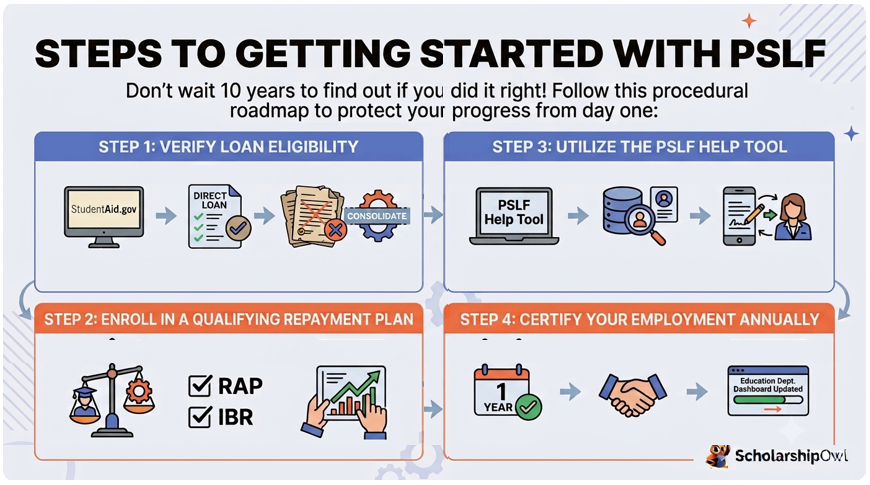
Don’t wait 10 years to find out if you did it right! Follow this procedural roadmap to protect your progress from day one:
The PSLF Program Under the Trump Administration
Given the changing political landscape, many borrowers are anxious about the future of public service forgiveness. Here is exactly where the program stands:
Is PSLF going away?
No. PSLF is a statutory program created by Congress under the Higher Education Act. It cannot be abolished by executive order or a Department of Education decision. The core 120-payment structure remains fully intact, and finalized forgiveness discharges are legally protected.
What happened to the “Illegal Activities” rule?
The administration attempted to redefine “qualifying employer” to allow the government to disqualify non-profits or 501(c)(3) organizations deemed to engage in activities with a “substantial illegal purpose.” Targeted organizations that could have lost eligibility include organizations that participate in diversity, equity, and inclusion (DEI) activities or are assisting or advocating for undocumented individuals.
However, federal courts officially blocked and vacated this rule. The courts ruled that the Higher Education Act explicitly dictates that the Secretary shall cancel loan balances for those employed by a 501(c)(3), leaving the administration no authority to selectively disqualify non-profits based on their activities.
Ongoing and Future Changes
While the foundation of PSLF is secure, student loan management has shifted toward a new, streamlined framework. Under the One Big Beautiful Bill Act, the administration launched the Repayment Assistance Plan (RAP) to serve new borrowers as well as replace other repayment plan options for borrowers with legacy loans.
Frequently Asked Questions (FAQs)
How do I know if my employer or past employer(s) are approved for PSLF?
The easiest and most accurate method is using the federal PSLF Employer Search database embedded inside the PSLF Help Tool on StudentAid.gov. By typing in your employer’s Federal Employer Identification Number (EIN)—which you can find in Box b of your W-2 form—the database will instantly tell you if they are approved, ineligible, or under review.
I’m currently in an ineligible repayment plan. Can I change it? If so, how are past payments counted?
Yes, you can change your plan at any time by logging into StudentAid.gov and completing an Income-Driven Repayment application to switch to an eligible option like RAP or IBR.
Historically, payments made under an ineligible plan (like the Graduated or Extended plan) did not count. However, the Department of Education offers a PSLF Buyback program. If you have already completed 10 years of qualifying employment, you can request to “buy back” past months spent on an ineligible plan or certain forbearance states by making a lump-sum payment equal to what you would have owed under an IDR plan at that time.
How are past periods of non-payment (deferments/forbearances), including the COVID pause, accounted for?
Generally, standard deferments and forbearances do not count toward your 120 payments. However, the historic COVID-19 administrative forbearance is a major exception. The months during the federal payment pause count as qualifying PSLF payments as long as you were verified as working full-time for a qualifying public service employer during those months—even though your actual payment amount was $0.
Note: Following the court order terminating the Saving on a Valuable Education (SAVE) plan, months spent in administrative forbearance during the SAVE litigation do not inherently count toward PSLF. You must select a new plan (like RAP) to restart your count.
When should a borrower choose NOT to consolidate an FFEL loan?
While consolidating is the only way to make legacy FFEL loans eligible for PSLF, you should actively choose not to consolidate if you fall into any of these categories:
-
-
-
Your payment count resets to zero: The temporary federal waivers that preserved past payment histories upon consolidation have expired. If you consolidate an FFEL loan today, any progress you have made over the last several years disappears, and your 120-payment clock restarts from scratch.
-
You are close to retirement or leaving public service: Because consolidation triggers a brand-new 10-year public service commitment, it is counterproductive if you plan to move to the private sector or retire within the next few years.
-
You have a low loan balance: Consolidating rounds your new interest rate up to the nearest one-eighth of a percent and instantly capitalizes your unpaid interest (adding it to your principal balance). If you only owe a few thousand dollars, the administrative reset will likely cost you more than just paying it off aggressively.
-
You want to keep legacy IDR timelines: Under current rules, executing a new consolidation automatically forces you into the new Repayment Assistance Plan (RAP). RAP carries a standard 30-year track for non-PSLF forgiveness—meaning if you fail to finish your 10 years of public service, you are locked into a significantly longer repayment timeline than legacy options like standard IBR.
-
-
I’m not working for a PSLF-eligible employer. Are there other ways to access forgiveness?
Absolutely. If you work in the private or corporate sector, you cannot use PSLF, but you can use traditional Income-Driven Repayment (IDR) Forgiveness. Plans like the new Repayment Assistance Plan (RAP) will automatically forgive any remaining loan balance after 30 years of consistent payments. Standard IBR discharges remaining debt after 20 or 25 years (depending on when you borrowed). Keep in mind that traditional IDR forgiveness may carry state-level tax implications depending on your residency.
The Final Stretch: How Long Does Forgiveness Take?
Once you cross the finish line, hit your 120th qualifying payment, and submit your final signed PSLF Form via StudentAid.gov, the processing window begins.
Standard PSLF Processing Timeline
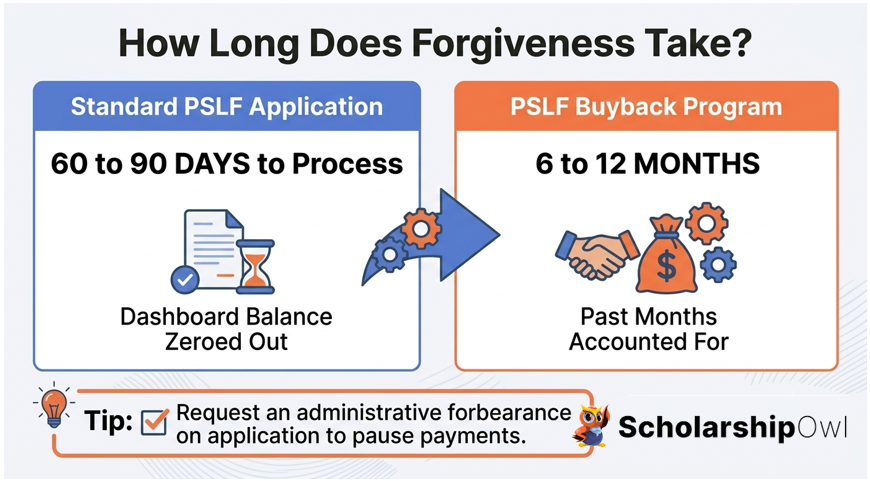
Currently, standard PSLF applications take 60 to 90 days (1 to 3 months) to process from submission to seeing your loan dashboard balance formally zeroed out.
Pro Tip: If you have been certifying your employment annually, your final processing window is generally much faster because the Department of Education only needs to audit your final 12 months of employment rather than a full decade of work.
The PSLF Buyback Exception
If you are relying on the PSLF Buyback program to buy back past months spent in an ineligible forbearance or deferment state to cross the 120-payment mark, expect a significantly longer wait. Due to operational processing volumes, Buyback requests are currently taking 6 to 12 months to be reviewed and approved. Once approved, you have 90 days to submit the required lump-sum payment, after which your account balance is typically cleared within 2 to 4 weeks.
Do I have to keep paying while I wait?
No. When you submit your final PSLF form, you can check a box to request an administrative forbearance while your application is under review. This pauses your monthly payment obligations entirely. If you choose to keep paying through the processing window anyway, any extra payments you make past number 120 will automatically be refunded to you once your discharge is finalized.
The Ultimate Solution: Avoid Student Debt Entirely
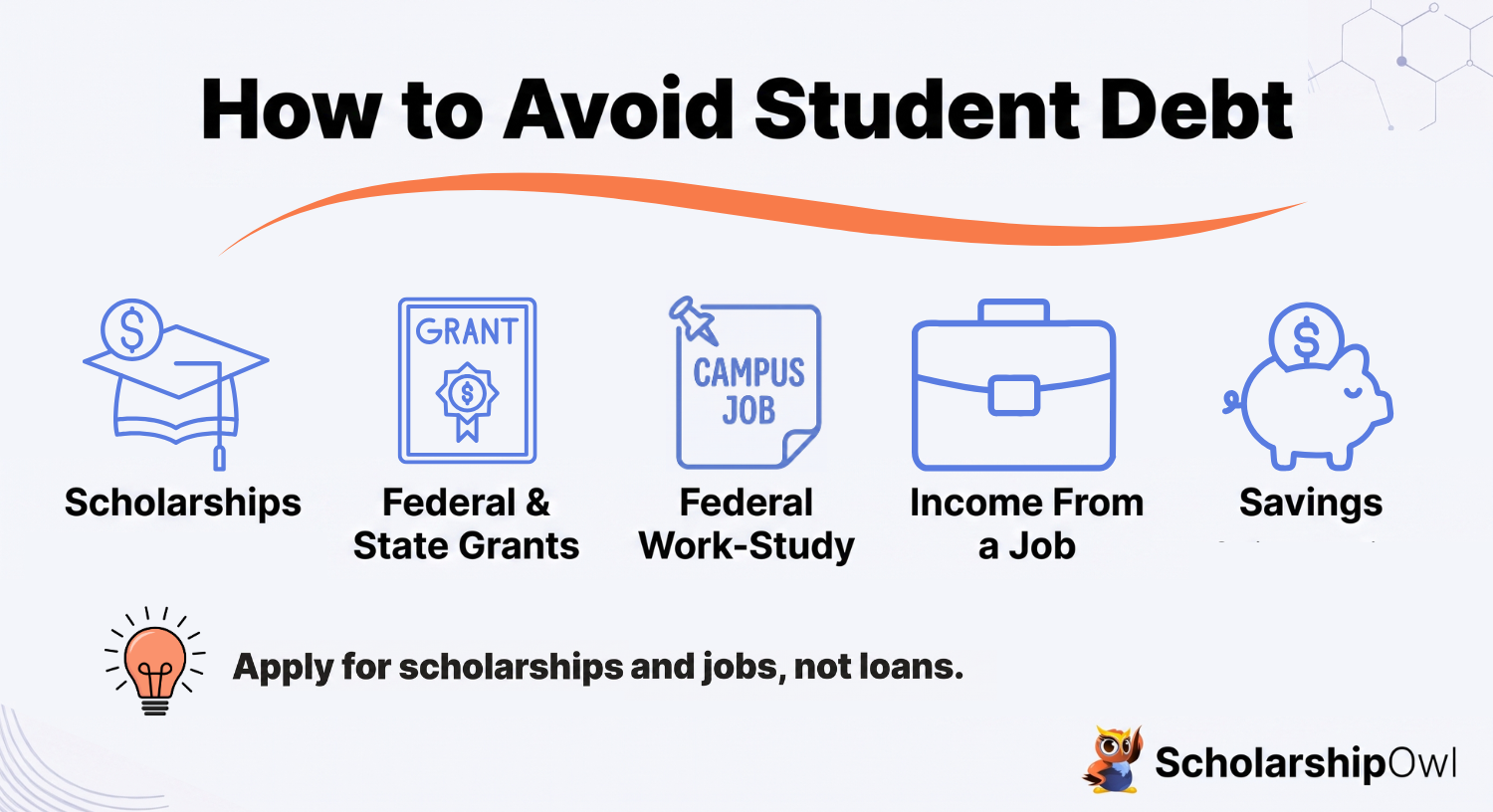
While PSLF is a phenomenal safety net, spending 10 years tracking paperwork and keeping your income restricted to the public sector isn’t the perfect path for everyone. The best way to manage student debt is to avoid borrowing it in the first place.
By prioritizing debt-free sources of funding, you preserve your financial freedom right out of graduation. Excellent alternatives include:
-
Grants: Need-based federal funds like Pell Grants that do not require repayment.
-
Work-Study Programs: Federal campus employment that lets you earn wages directly toward tuition.
-
Scholarships: Merit, need, or interest-based gift aid funded by private foundations, corporations, and universities.
Accelerate Your Debt-Free Journey with ScholarshipOwl
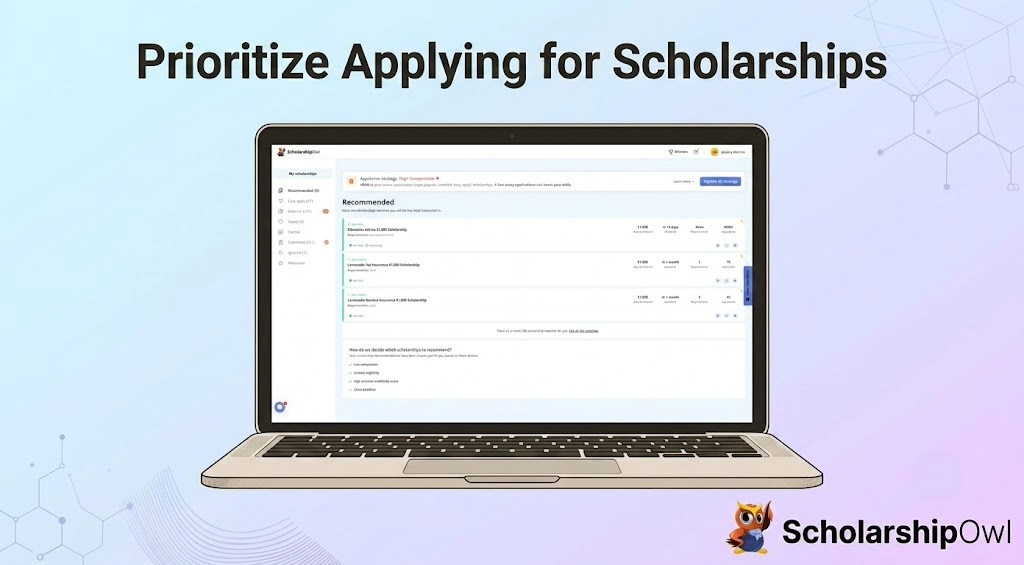
If you want to bypass the stress of federal loan forgiveness altogether, winning scholarships is your highest-leverage strategy. This is where ScholarshipOwl gives you an unfair advantage over the standard applicant pool.
Instead of treating scholarship hunting like a grueling second job, ScholarshipOwl utilizes advanced technology to streamline your success:
AI-Powered Recommendations
The platform doesn’t just give you a generic list; it uses smart matching algorithms to suggest highly personalized scholarships customized to your specific background, field of study, and unique skills.
Universal Application
Apply to all of the scholarships in your match list without having to complete a single application form! Your profile serves as a universal application for all of the scholarships in your match list. using your pre-saved student profile.
Applicant Volume Transparency
ScholarshipOwl lets you see exactly how many people have applied to each scholarship in your match list. This allows you to selectively target lower-competition scholarships where your mathematical odds of winning are significantly higher.
Credibility Scoring System
Protect your data and your time. The built-in security evaluation system scores each scholarship provider, ensuring you only spend your energy applying to authentic, verified awards.
Not yet a member of ScholarshipOwl? Get started today with a free 7-day trial!
Conclusion
The Public Service Loan Forgiveness program remains a powerful tool if you are dedicated to an impactful career in the government or non-profit sectors. By keeping your loans within the Direct program, enrolling in the new Repayment Assistance Plan (RAP), and documenting your employment annually, you can successfully watch your debt balance drop to zero.
But remember, the single most effective way to protect your financial future is to minimize your reliance on loans from day one. Sign up for ScholarshipOwl today to match with curated, high-probability awards and build a truly debt-free education.
For Further Reading
- OBBBA Student Loan Impacts: Everything You Need to Know
- “One Big Beautiful Bill Act”: What It Means for Your College Journey
- Managing Student Loan Debt: The Ultimate Guide for Graduating Students
- The Road to Repayment: Survey Reveals Student Debt Expectations vs. Reality in 2026
- When “Yes” Costs Too Much: Smart Strategies for Paying for College
- How to Find and Apply for Scholarships That Are Truly Worth Your Effort
- Family Can’t Help Pay for College? No Problem: Your DIY Guide to Paying for College on Your Own